Not every herbicide service is alike. Whether the product type, timing and type of weeds in your lawn will determine a hold. This guide outlines professional herbicide services and how to assess a local service provider and questions to ask before they mow your lawn.
The typical search for herbicide services near me begins with a lawn that’s passed a point of no return. Perhaps the weeds are in the cracks of the driveway and/or the planting beds instead of just the lawn. Perhaps there was a spray last year and the same weeds are in the same places. Regardless, you’re beyond just picking up a spray bottle and hoping.
The issue is what is meant by ‘herbicide services’ can mean so many different things. A single annual spray is available at some companies. Others develop an entire season’s program of 5 or 6 visits around the life of the weed. Others employ commercial selective herbicides that are suited to the weed species. Some treat all lawns they visit the same, without considering the vegetation growing in them.
If you do know the difference you will save a season of frustration and money before hiring any person.
What Are Herbicide Services and What Do They Actually Include?
In the field of herbicide services, the use of chemical or organic products is employed to prevent or eliminate unwanted plants. Essentially, you’ve got to spend money on somebody who is aware of what product is right for the weeds, when to use it, and how to use it without damaging your lawn.
The simple visit consists of a tour of the field, weed identification, product recommendation, and application. A complete seasonal program includes several visits made at the proper stage of the weed’s life cycle, and further follow-up visits for weeds that continue to emerge and adjustments to the program.
That’s a big difference. A single visit can destroy weed growth that is seen. A seasonal programme really treats the underlying cycle that re-establishes weeds every year.
What Are the Main Types of Herbicide Treatments?
Learning the categories will enable you to ask the right questions when you are looking for a comparison between providers.
Are Pre-Emergent Herbicides Worth Using?
Of course, particularly for annual plants such as crabgrass and puncturevine. Pre-emergent herbicides are applied before the seeds germinate and create a barrier to prevent seedlings from establishing themselves in the soil, according to Utah State University Extension. They are not therapeutic, but instead preventive. A pre-emergent will not affect the lawn if the crabgrass is already growing.
The key to this type of treatment is the timing. Soil temps between 50 and 55 °F indicate crabgrass will emerge within weeks, according to USU Extension. This is your opportunity. Seed will be up if two or three weeks are missed. At that time the product is inactive.
A second application in the midsummer fills in a window missed by most one-time applications.
When Do Post-Emergent Herbicides Make More Sense?
Post-emergent herbicides are used after the weeds have emerged and are growing. Systemic post-emergents are absorbed by the leaf and then moved through the vascular system of the plant to the root, making them more effective on established weeds than contact-only products which only kill the foliage that they hit.
The order is still important here. Weeds take in herbicide best when they are actively growing and not heat or drought stressed. In West Jordan, a dandelion may be less effective after a July heat wave than if it is treated at the same time in April or September when the plants are growing and conditions are ideal.
What Is the Difference Between Selective and Non-Selective Herbicides?
Selective herbicides are herbicides that will kill a specific type of plant, such as broadleaf weeds or grassy weeds but not the grass in your lawn. A broadleaf product will kill dandelions and clover, but will not affect the grass. This selectivity is inherent in the chemistry of the herbicide product and is a first step that cannot be overlooked in matching the herbicide to the weed type, according to Weed Pro’s herbicide classification guide.
Non-selective herbicides are systemic, meaning they will affect any plant that they come in contact with. The most popular example is Glyphosate. These should be used in hardscape, areas where all vegetation is to be removed, gravel paths and fence lines. When a nonselective product is used on a lawn without exact application, the overall damage to the lawn can be quite extensive, and may take months to recover.
If a company employs a product on a fence line that’s the same product you’re using on your lawn, that company is not paying attention to what should be done.
Is There a Place for Organic Herbicide Treatments?
Yes, but there are consequences. Products such as iron-based, corn gluten meal and acetic acid are less harsh on soil. Ideal for garden beds, near food plants, and homes with young children and pets.
Effectiveness is the limitation. Home-made or organic herbicides can kill annual weeds, but may not work on perennial or established weeds, according to Big League Lawns’ lawn care research, Utah. Bindweed infestations that have been present and growing for 2 to 3 seasons and serious infestations of crabgrass generally require more than an organic approach to achieve the level of control most homeowners are seeking.
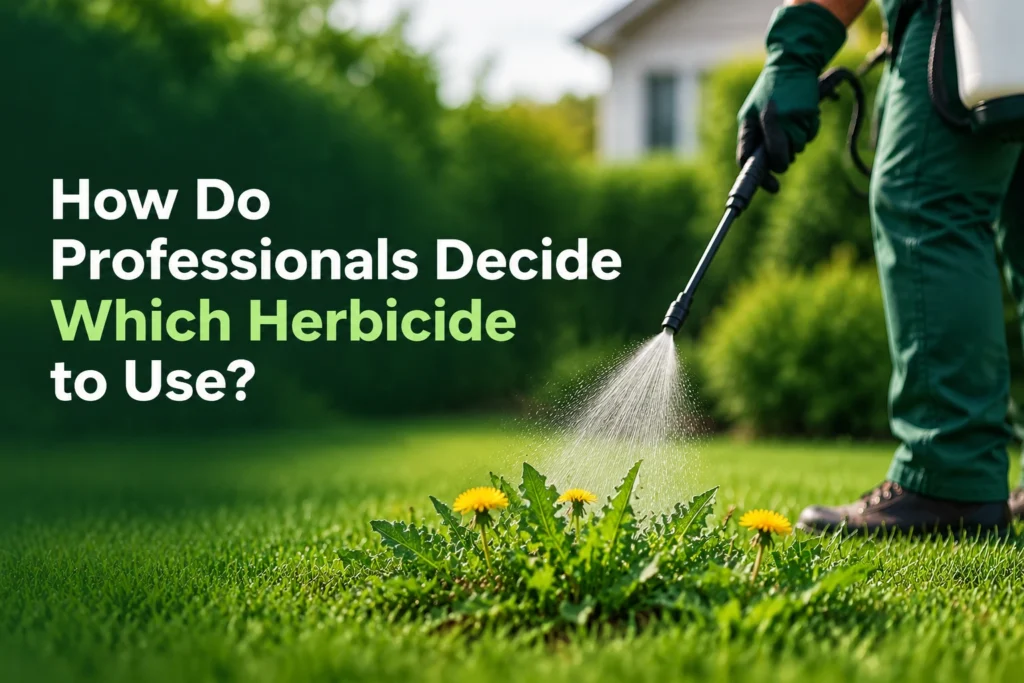
How Do Professionals Decide Which Herbicide to Use?
When you do ask this question, it is the most revealing one for any homeowner.
The first step to making a good decision by a professional is identification. The weed chemistry is different for various weeds. Nutsedge and yellow sedge require special ingredients such as halosulfuron or sulfentrazone. They’re contacted by no regular broadleaf products. Tall fescue growing in a bluegrass lawn needs a totally different approach than clover or dandelions. What ever it’s applied, the treatment cannot do anything if it is wrong ID.
Timing, after identification, will refer to growth stage of the weed. In August, a post-emergent treatment on an established stand of crabgrass is not very effective. This same product is more effective when applied to a young plant in June. Post-emergent herbicides work best when applied in late summer and fall, when the nutrients are being translocated into the roots. The top growth is achieved with the same product in May, while the roots are mostly preserved.
Next, the selection of the product in relation to the surrounding turf. Certain selective herbicides are not effective against all types of grass. LawnStarter’s post-emergent herbicide research notes that it is important to read the herbicide label before application to make sure that the herbicide is compatible with the type of grass. Some selective herbicides are highly effective on one type of grass but not on another. If you have Kentucky bluegrass, tall fescue and sometimes bermudagrass in the southern parts of Salt Lake County and Tooele County, then you should consider those differences.
Last but not least application rate and method. If the concentration is not high enough, the weed lives. Concentrations that are too high can lead to phytotoxicity to surrounding grass. Commercial equipment is set to the right output rate and provides much more even coverage than a pump sprayer from the hardware store.
What Should a Seasonal Herbicide Service Plan Look Like in Utah?
One visit covers everything that you can see on one day. A seasonal plan takes into account the entire weed pressure throughout the season. Here’s how that looks on lawns throughout West Jordan, Salt Lake County, Tooele County and Davis County.
Early Spring (March to April)
Window of opportunity for pre-emergent. The soil temperature testing begins in late February. When the readings reach around 50 degrees, the window is open. USU Extension recommends a second application in some instances for additional coverage during the entire crabgrass and puncturevine germination season. Early post-emergent work of dandelions also occurs this period, which is great to do before the summer heat.
Late Spring (May to June)
Warm season broadleaf species, such as clover, plantain, spurge are actively growing. A targeted post-emergent pass here will be able to harvest any plants that went through the pre-emergent barrier. Bindweed is found in late May throughout the Wasatch Front. If it can be treated while young, it will be more productive than if treated when climbing.
Midsummer (July)
Second pre-emergent is applied to a second problem with late germinating annual weeds. Surface treatments are continued for spurge and any visible annual broadleaf growth as needed. Apply early in the morning on still days. The stress of high heat can result in product drift and stress turf already under stress at 90 degrees.
Late Summer to Early Fall (August to October)
A time when the perennial weeds may be attacked most effectively. Moving nutrients from leaves to roots for dormancy. When applied as post-emergent, that applied nutrient will travel with those nutrients and go to the root better than at any other time. Fall treatments may sometimes be more effective than spring treatments for bindweed and established dandelions.
A fall pre-emergent will also prevent winter annuals such as annual bluegrass and hairy bittercress from establishing.
End of Season Review
A good provider doesn’t just turn off at the end of the season. They record the location, time and treatment. They record those weeds that regrew, areas of thinning, and what adjustments need to be made to the plan next year. It is not a random visit, but rather a review.

How Do You Evaluate Herbicide Services Near You?
The providers that appear in the local search results can be quickly determined by just a few simple questions.
Do They Identify Before They Treat?
The first step is the most important, and any provider that doesn’t do it is missing a step when they come up with a price before they walk your lawn. ID drives everything. If you don’t, you’ll be paying for a guess. A good pro walks the house first and then tells the owner what he/she sees and then offers the owner suggestions.
Can They Tell You What They Are Applying and Why?
It is important to be familiar with the active ingredient, the type of product it is, and for what reason it was selected to be used for the weeds. If it is not specific, or it’s only the brand names, request clarification again. This is clearly explained and unfaced with opposition by a licensed applicator.
Are They Licensed Through the Utah Department of Agriculture and Food?
Commercial pesticide applicators must be licensed by the Utah Department of Agriculture and Food. It is not optional. Ask directly. A genuine company responds promptly.
What Does the Follow-Up Plan Look Like?
A one-time application is used for what you see today. They never come into contact with seed banks, deep roots or subsequent germination waves. Inquire about the number of visits, what causes the return visit, and what will happen when weeds return between visits. If a company is sure of its work, a reservice policy is a reasonable expectation.
Do They Know Your Local Area?
Weed pressure in West Jordan is not the same as weed pressure in Tooele County, and is not the same as in Davis County or St. George. Puncturevine tends to grow more abundantly in the southern and western parts of the area in close association with disturbed or dry soil. Bindweed is patchy. A company that knows its business inside and out will account for that, rather than applying the same plan to all lawns.
What Red Flags Should Make You Look Elsewhere?
There are few things that will make as quick and as obvious a statement about the wrong provider as this will.
A phone quote that hasn’t been seen is not a real quote for you. A legitimate herbicide service charges you for the size of the lawn, the weed pressure and the kinds of weeds that need to be treated.
If weeds such as bindweed or perennial broadleaf species have been present for several seasons, then a one-visit cure is not feasible. Honest providers give accurate time scales.
No description of product being used and/or its purpose. You have a right to that information. If it is viewed as having no value, or as company property, then it is not being used transparently.
No plans for follow up. If the discussion finishes with “we’ll spray it and call you if you have questions” then it isn’t a seasonal program! It’s a single service being offered as if it’s a bigger service.

Lawn Habits That Make Herbicide Services Work Better
Weeds which are in place are dealt with by professional treatments. Those results can last longer between visits, with a few simple routines at home.
Mow the lawn at the proper height in relation to the grass species. Taller grass provides shade to the soil surface and decreases the sunlight required for weed seed germination. A height of about 3 inches is suitable for Kentucky bluegrass, which is widely planted throughout northern Utah.
Water deeply, infrequently, not every day. Shallow watering helps to keep the top inch of soil moist, which is ideal for shallow rooted weeds. If irrigation is done deeply and infrequently, grass roots will go deeper into the ground, allowing the turf to be truly competitive in suppressing annual weed germination.
Reseed bare or light stands ASAP. Almost all types of weeds can enter through open soil. The more time you leave a bare spot in your lawn unfilled, the greater the chance that something you don’t want will grow there before your grass grows.
Fertilize according to schedule. A healthy, thick grass will out-compete weed seedlings. Weeds get a head start in thin, nutrient-poor turf, and a weak lawn cannot make up for the losses caused by herbicide programs.
Frequently Asked Questions
How long does it take to see results after a herbicide treatment?
Post-emergent herbicides typically show visible effects within a few days as treated plants begin to wilt and discolor. Full kill of the above-ground growth usually takes one to two weeks depending on the species and the product used. Root death, which determines whether the plant comes back, takes longer for systemic products working through the vascular system.
Is it safe for kids and pets after a herbicide service?
Licensed providers apply products according to label guidelines and give you a specific re-entry window after the application dries. For most residential lawn herbicide treatments, that window is a few hours. Follow the guidance given for your specific treatment, not a general estimate from somewhere else.
Why did the weeds come back after treatment?
The most common reasons are a timing miss on the pre-emergent window, a product that did not match the specific weed species, incomplete kill on perennial species with deep root systems, or new seeds germinating from the soil seed bank that the treatment did not address. A provider who is honest about what went wrong after a weak result is worth keeping. One who goes quiet is not.
Can herbicide treatments damage nearby garden plants or trees?
Selective products stay where they are applied and only hit the plant types they target. Drift on windy days is a real risk, so apply on calm mornings. Non-selective products need extra care near anything you want to keep.
How many visits per year does a proper herbicide program include?
Most Utah lawns need four to six visits a year. Spring pre-emergent, late spring post-emergent, midsummer re-application, late summer perennial treatment, and a fall pass. Lawns with lighter pressure or after a year or two on a solid program sometimes need less.
Can herbicide services be combined with fertilization?
Yes. A healthy lawn fights weeds on its own, so combining the two in a seasonal plan makes sense. Many programs include both. Ask your provider if your lawn is ready for combined treatment or needs to stabilize first.
What is the best time of year to start an herbicide service program?
As early as possible in late winter or early spring. The pre-emergent window in March and April is the most important treatment point of the year. Starting after weeds are already up means playing catch-up all season, which is a much harder spot to be in.
Making the Right Decision
There are some similarities when it comes to the best herbicide services near you. They ID before they spray. They describe what they use and why. They develop a complete season schedule. The technicians are also licensed applicators in the State of Utah.
Those are the features that make a lawn superior year after year as opposed to a lawn that is treated in the spring and remains the same by July.
Repeated weed services are required to control long-term weed issues. USU Extension explains the science behind it. What makes providers different is their execution, and the questions above will help you determine who can deliver.