You know the moment. It’s Saturday morning, coffee in hand, and you wander out to check the lawn. And there it is. One bright yellow dandelion, sitting dead center like it pays rent. You pull it. By the next weekend, four more have shown up.
Weeds are stubborn that way. They don’t care how much you water or how straight you mow.
We’re Weed and Pest Control Specialist, a small family company in West Jordan, and we’ve been working on Utah lawns since 2014. This guide holds the stuff we’d tell you over the backyard fence. If you’ve been searching for the best weed control service in Northern Utah, a few basics about weeds, timing, and hiring can save you money and a lot of kneeling in the grass.
We’ll cover why weeds do so well here, which ones cause the most grief, and how weed killers really work. Then we’ll go over what to ask any company before you say yes. Yes, even us.
Why Do Weeds Love Northern Utah?
The weather in Utah is tough on the lawn and easy on the weeds. Winters get cold. During the summer months it becomes hot and dry, sometimes even for weeks. Weeds shrug it off. Many of them are built for this, and they take off once spring warms up. There’s also a lot of weed seed, and a green sprout shows up in July
Dry Summers, Deep Roots
Imagine a dandelion and a lawn of grass on a hot summer day. The grass has short roots, and dries quickly. The dandelion’s one long root plunges far down, and it continues to drink from the deep soil. Which of the two will be the better looking by August? When the grass cover is reduced, weeds invade the open spaces.
Compacted and Clay Soil
Many yards are built on compacted ground or on heavy clay. The stuff is hard for grass roots. The lawn becomes thin, thin lawns get bare patches, and weeds love a bare patch. So as we discuss weeds, we discuss watering and feeding, as well. It’s all tied together.
Seeds on the Move
Weed seeds are light. Wind carries them. Birds drop them. They attach themselves to shoes, mower wheels and dog fur. It is possible to baby your lawn and still lose to the empty lot down the street. Hence, one single weeding spree, usually on a weekend, is rarely enough to remedy matters. A plan that continues will do.
The Weeds We See Most
Each weed has its own vices. Memorize them, and you’ll be able to choose your battles more effectively.
Dandelions and Other Broadleaf Weeds
Dandelions are the “poster-child” broadleaf weeds. Clover, plantain and chickweed are in the club as well. The problem is dandelions have roots as long as a skinny carrot. Pull off the head and it will bloom again, maybe even more aggressively. The weed killers that are sprayed on broadleaf weeds penetrate through the leaf and down to that root. It’s the area where your fingers can’t reach.
Crabgrass
Crabgrass sneaks in. It’s a couple small tufts that you don’t even notice in the late spring. It grows into a large, light green, flat spread by mid-summer resembling a crab’s legs. It is an annual plant, which will be killed by frost but not before dropping a mass of seed for the following year. The only “trick” is to prevent those seeds from germinating.
Field Bindweed
If you had to pick the most tormenting weed, this is the top one. Vines of field bindweed cling to anything that doesn’t move and the flowers are small, white to pink, similar to a small morning glory. The roots are deep and a small fragment will regrow. So, no matter what a flyer claims, it does not always go away after a single visit. Look out for any person claiming that they don’t.
Canada Thistle
Creeping roots, purple flowers, and spiny leaves. A corner of a yard can become overrun with Canada thistle without you knowing it. It hurts to pull it by hand and it leaves root behind to try again.
Puncturevine
You may not know puncturevine by name, but you’ve probably felt it! Those little burrs are called goatheads. That’s the one. It prefers warm, dry soil at driveways, sidewalks and gravel. Deal with it before it makes burrs.
Utah keeps an official noxious weed list, and property owners share the job of controlling those weeds. You can see the current list on the Utah Department of Agriculture and Food noxious weed list page.

What a Good Weed Control Service Should Do?
So what should you look for? If you’re comparing companies and hoping to land the best weed control service in Northern Utah, pay attention to how they behave before they spray anything.
They should get to know your yard first. How big is it, which weeds are there, and how healthy is the grass? Treating a lawn you haven’t studied is just guessing with a sprayer.
Then comes the plan. You should be able to hear it in plain English: what’s going on the lawn, why, and when. Vague answers are a warning sign.
The right product matters more than most people think. Something that wipes out dandelions might leave crabgrass completely untouched. A trained applicator knows the difference, which is the main reason to hire one instead of grabbing whatever’s on the hardware store shelf.
Every product also comes with a label, and the label has rules. How much, how often, and how long the kids and the dog should stay off the grass. A good company follows those rules to the letter.
And weeds do come back. That’s just life. So the last thing to look for is a company that returns, checks the yard, and fixes whatever shows up. With us, most additional treatments are free with a paid service plan, and our Green Satisfaction Guarantee stands behind the work.
Want the deeper version? We wrote a full guide to herbicide services that walks through the different kinds of treatments and the questions to ask.
Pre-Emergent and Post-Emergent Weed Control
These are the two large words that you will hear on your first call. Don’t let them scare you. The ideas are simple.
Pre-Emergent: Stop Weeds Before They Sprout
A pre-emergent product makes a thin barrier in the top layer of soil. Weed seeds attempt to grow and fail against it. The trick is all in the timing, as the product needs to be down before the seeds awaken. Utah State University Extension has shared the following for the Wasatch Front, Utah: the last day to apply crabgrass preventer is about April 15. An old sign for the gardener works as well: get it down before the lilacs bloom.
If the window is missed then the product cannot kill weeds that are already growing. One more thing. Tell your technician first if you need to re-seed your lawn, as pre-emergent products can block grass seed, too.
Post-Emergent: Treat Weeds That Already Grew
Post-emergent products are used to control weeds that are already visible. There are some made for broadleaf weeds and others for grassy weeds. A little patience is needed with tough customers such as bindweed, as they might require multiple applications.
Most lawns require both types. Pre-emergent prevents the new stuff from sprouting and post-emergent removes the leftover stuff.
Still uncertain what your lawn needs? Call or text us at 801-669-8200, or make a request via our contact us form. We will conduct a yard evaluation and assist you in selecting a plan that will fit your yard.
A Simple Year-Round Weed Management Plan
Getting rid of weeds is not a one day task. It goes through the seasons like your lawn.
Early Spring
It’s the pre-emergent time of the year. Also, rake the remaining leaves. A clean yard will reduce the hiding spots for weeds.
Late Spring and Summer
Now the weeds are growing like crazy. Spot treatments kill them before they produce seed. Mow on the high side, as taller grass will shade the soil and make it more difficult for weed seed to survive. Water deeply but infrequently, encouraging the roots to grow downwards.
Fall
The fall is a good time to attack perennial weeds. These plants are now storing food in the roots for winter. If treated soon, the weed killer will travel with that food all the way down. This is also an ideal time to re-seed bare areas and to feed your lawn to get it growing back healthy.
Winter
Your lawn is sleeping, and so are you! However, it’s a good time to recap the year in the winter. Where did the weeds get the edge? Tell that to your tech and next year’s going strong.
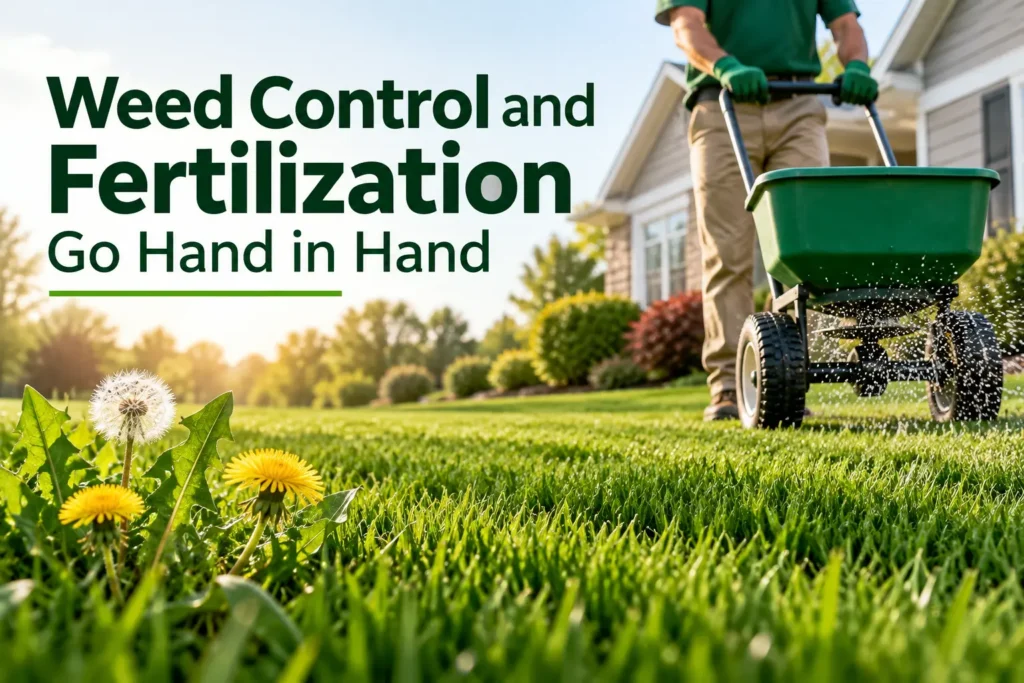
Weed Control and Fertilization Go Hand in Hand
The best weed fighter you own is a thick lawn. Weeds are smothered and have no space to grow in thick grass. Grass does require food for thick growth and fertilizer is the food to be applied at the right time in the correct amount.
Too much can hurt your lawn, and too little leaves it weak. That’s why we treat feeding and weed control as one plan. Read more about our lawn and tree treatment services to see how the pieces fit together.
Weeds in Flower Beds and Gardens
Weeds love flower beds just as much as lawns. Beds need a gentler hand, though. A spray that works on grass can hurt your flowers, so many beds get handled by hand or with careful spot work.
A thick layer of mulch helps a lot. It blocks sunlight, so fewer seeds sprout. Pull weeds when the soil is damp, because the roots slide out easier. If your beds need extra help, take a look at our flowers and gardens services.
Weed Control for Businesses
Weeds aren’t only a home problem. A weedy parking strip or a messy entrance can make a shop or office look ignored, and customers notice the little things.
Most business owners don’t have time to fight weeds on their own. A steady service plan keeps the grounds neat without the extra work. We welcome home and business accounts alike, and our commercial services page has the details.
Areas We Serve
Typically, people look for weed control service near them when searching for the best. Local matters. Knowing the weeds, the weather, and the soil is something that a company that works in your area already knows.
Service is provided in Salt Lake, Tooele and Davis counties, and the St. George area. Let’s quickly summarize each of them.
Salt Lake County
The busiest area of the valley is Salt Lake County. Older communities with large lots and newer homes on smaller lots are all around. We’re located in West Jordan within the county. Weed control in every yard must be planned to fit the lawn size, big or small.
Tooele County
There is a considerable amount of open space in Tooele County. Many properties are adjacent to open ground, thus increasing wind-blown seed contamination. In some communities, such as Tooele and Grantsville, homes can see weed growth in adjacent fields. These weeds are well controlled when treated regularly.
Davis County
Davis County is located between the Great Salt Lake and the mountains. Neighbors in communities such as Layton, Bountiful and Kaysville expect neat lawns and safe play areas for their children. Weed control helps to maintain a thick green grass.
St. George
St. George is located in southern Utah where it is hotter and drier and may require slightly different timing for treatment. Call us and we’ll confirm service for your address.
Questions to Ask Before You Hire
Picking the best weed control service in Northern Utah gets easier when you ask good questions. Try these on your first call, whether it’s with us or anyone else. We also wrote a separate piece on how to choose a professional weed spraying company if you want more.
Ask if the company is licensed. In Utah, the Utah Department of Agriculture and Food handles licensing for people who apply pest control products for pay. We’re licensed, and we’re happy to talk about it. Ask about insurance too.
Ask how many visits the plan includes and what happens if weeds return between visits. Get the details of any guara ntee in plain words, so you know exactly what’s covered.
Ask which products will be used. A good company explains that in simple terms. Ask how long kids and pets should stay off the lawn, and what you can do to help, like how high to mow or how often to water.
And ask how they handle tough weeds like bindweed. An honest answer includes patience and repeat visits. Big promises are a red flag, because nobody controls nature perfectly.
Keeping Kids and Pets Safe
Safety is the first worry for many families, and that’s fair. Your yard is where the kids play and the dog runs.
Products come with label rules, and we follow them. Many labels say to keep people and pets off the lawn until it’s dry, and we’ll tell you what applies to your yard. We use an Integrated Pest Management approach that includes organic products. Prefer organic? Just say so when you call.

Should You Do It Yourself or Hire a Pro?
Some folks like handling weeds on their own, and that’s fine for small jobs. Pulling a few dandelions is easy. A small garden bed makes a good starting point.
Bigger yards get tricky fast. It’s easy to pick the wrong product, spray at the wrong time, or use too much and burn the grass. Some products aren’t sold to the public at all, and our team is trained to use them.
A pro also gives you your weekends back. Picture your Saturday at the park with your family instead of bent over the lawn. For most people, that’s an easy choice.
About Weed and Pest Control Specialist
We’re a woman-owned, family-run company. We’re a mom-and-pop business, which means more personal service than a big corporation can give. Our office is at 7103 South Redwood Road #107 in West Jordan, Utah.
We do more than weeds. We also offer lawn fertilization and pest control for homes and businesses. Fighting bugs along with weeds? Check out our residential pest control page, or browse more lawn and pest tips on our blog.
We’re open Monday through Friday, 9:00 AM to 5:00 PM. Use our contact us page to ask for a quote.
Common Questions About Weed Control
How Much Does Weed Control Cost?
It depends on the size of your lawn, the weeds you have, and the plan you pick. The easiest way to get a real number is to ask. Send a request through our contact us page and we’ll get back to you with a quote.
How Many Visits Will My Lawn Need?
That depends on your lawn too. Many plans use several visits across the growing season. Once we see your yard, we’ll tell you what makes sense.
When Is the Best Time to Start?
Early spring is great, because pre-emergent works best before weeds sprout. Missed it? Don’t sweat it. Weeds that are already growing can still be treated, and fall is a strong time to go after perennial weeds.
Can I Just Pull the Weeds?
Pulling works for young weeds with shallow roots. It isn’t enough for deep-rooted ones like dandelions and bindweed, since any root left in the ground can grow back. Pulling also does nothing about the seeds already sitting in your soil.
Ready for a Weed-Free Lawn in Northern Utah?
A good-looking lawn doesn’t happen by luck. It takes good timing, a steady plan, and people you can trust. The best weed control service in Northern Utah will look at your yard, explain the plan in plain words, and come back when the weeds do.
Whether you live in Salt Lake County, Tooele County, Davis County, or the St. George area, you deserve a yard you can enjoy. Make the call. Ask your questions. See if we’re the right fit.